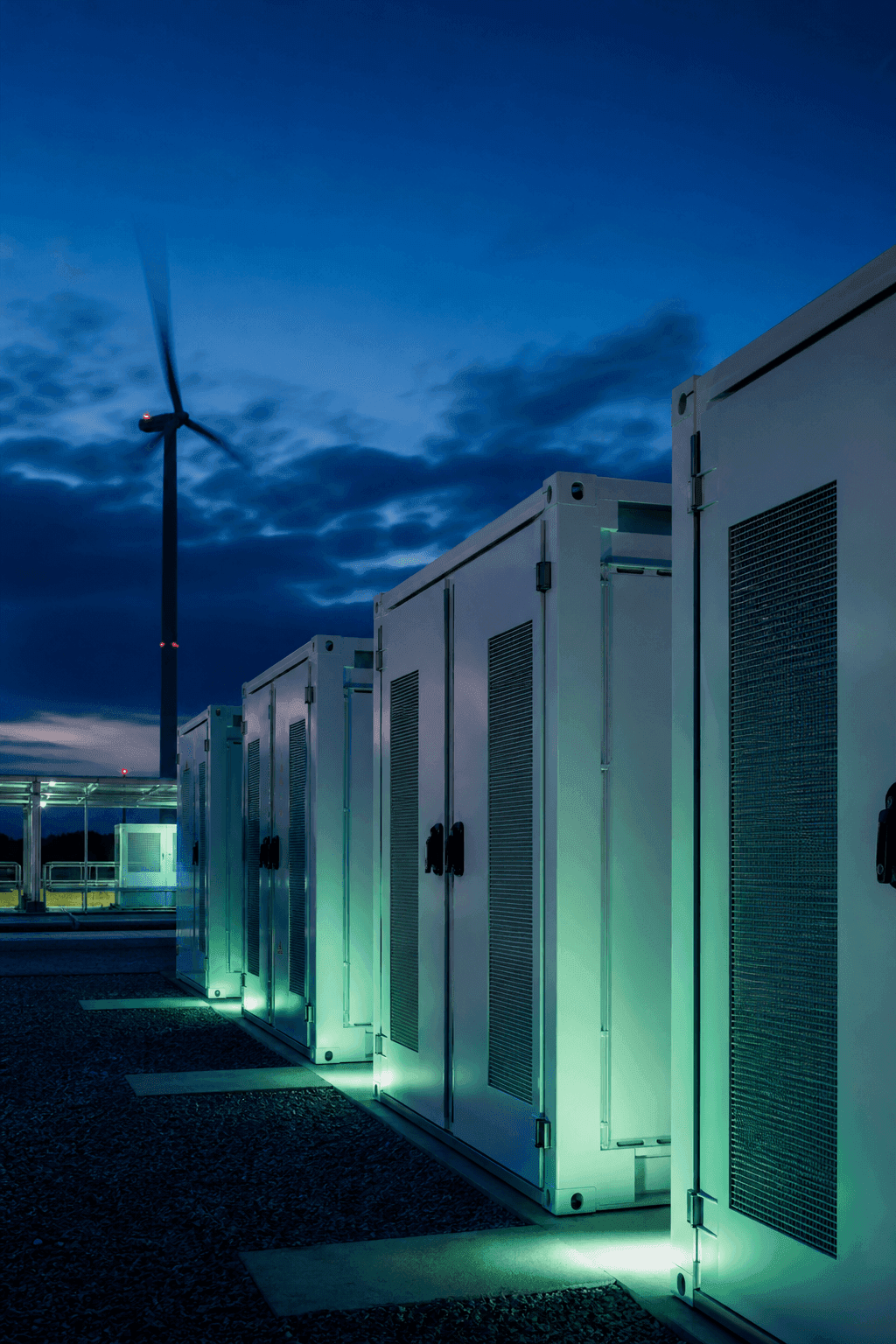
Behind-the-meter BESS
Facility-scale storage that reduces demand charges, enables load shifting, and strengthens on-site resilience under clear tariff and operating rules.
Whether the priority is tariff economics, renewable firming, or deeper backup, each configuration is engineered for operability and for coexistence with UPS-protected loads.
Facility-scale storage that reduces demand charges, enables load shifting, and strengthens on-site resilience under clear tariff and operating rules.

Architectures that extend ride-through and coordinate charge/discharge with existing uninterruptible power so protected buses stay deterministic under stress.

Smooth PV output, manage ramps, and improve bankability of hybrid energy systems on industrial and campus grids.

Hybrid energy controls
Controls and protection schemes that let storage add economic and resilience value-without creating new single points of failure or ambiguous behaviour during transfers.
A BESS business case survives scrutiny when use cases are sequenced: tariff first, resilience second, or renewables firming as the primary driver-with clear telemetry for each.
Shift or shave peaks to reduce tariffs while keeping process and IT loads fully protected during discharge events.
Extend autonomy for critical loads during prolonged disturbances when generator fuel logistics or grid recovery windows are uncertain.
Peak-shaving sizes to tariff intervals and load shapes; backup sizes to critical-load autonomy and recharge assumptions. Trident separates these duties in concept studies so dual-use designs carry explicit SOC reserves and priority rules rather than spreadsheet optimism.
Interval demand data, single-lines, UPS/generator inventory, and tariff structures feed models that recommend power/energy ratios worth taking to detailed design-before enclosure or chemistry fashion decides the project.
Energy management modes define what storage may do during UPS transfer, generator operation, and islanded states. Ambiguous paralleling is the common failure mode of hybrid projects; explicit hierarchy is the remedy.
Chemistry-specific thermal runaway strategy, detection/suppression interfaces, and AHJ coordination are engineering deliverables. Containerized packages accelerate deployment only when civil, interconnection, and fire strategy still govern the real schedule.
Commissioning and monitoring prove yield to tariff and resilience targets alike. Lifecycle programmes track capacity health so the business case that justified BESS remains measurable as the asset ages.
Answers that address chemistry, safety coordination, and how storage interacts with critical power.
By defining hierarchy and modes before equipment is ordered: which bus the BESS ties to, what it may do during UPS transfer or generator operation, and how EMS setpoints interact with UPS autonomy targets. Ambiguous paralleling is where hybrid projects fail; explicit modes are where they succeed.
Chemistry-specific thermal runaway strategy, detection and suppression interfaces, egress and separation distances, and coordination with the authority having jurisdiction and insurer expectations. We treat the safety case as part of engineering deliverables-not a late procurement checkbox.
Factory integration often shortens site electrical and mechanical work, but civil pads, interconnection, fire strategy, and EMS integration still govern the schedule. Containerized wins when the package matches duty and site constraints; custom indoor rooms win when density, aesthetics, or existing buildings dictate.
Peak shaving sizes power and energy to tariff intervals and load shapes; backup sizes to critical-load autonomy and recharge assumptions. Dual-duty designs need explicit priority rules so economic cycling does not deplete the resilience reserve when an outage arrives.
Interval demand data (ideally 15-minute), single-line, UPS/generator inventory, solar plans if any, tariff structure, and resilience targets. With that we can model use-case stacking and recommend power/energy ratios worth taking to detailed design.
From chemistry selection to EMS integration and fire-safety coordination, we help you build a storage case that survives engineering, insurance, and operations review.
Factory-integrated enclosures that accelerate deployment while embedding HVAC, fire detection/suppression interfaces, and protection devices.